From 10.5" SBRs to 20" precision rifles — what actually changes with barrel length and why it matters.
AR-15 Barrel Length & Brand Report: Data from 15,000+ Builds
Quick Answer: Which Barrel Length Should You Choose?
Your ideal barrel length depends on your primary use case. Here's the short version:
- Home defense / CQB: 11.5" offers the best balance of velocity and maneuverability
- General purpose / do-it-all: 14.5" (pin and weld) gives you rifle ballistics in a compact package
- Range / hunting / precision: 16" is the standard for a reason — full velocity with no NFA paperwork
- Competition / DMR: 18"–20" squeezes every last fps from 5.56 NATO
If this is your first AR-15 build, start with 16". It's the most versatile length with zero legal complexity.
Scope note: All data, velocity figures, and recommendations in this guide are based on 5.56 NATO / .223 Rem builds. Other calibers (300 BLK, 6.5 Grendel, etc.) have different barrel length dynamics.
| Metric | Value |
|---|---|
| Builds Analyzed | 15K+ |
| Barrel Selections | 2,200+ |
| Barrel Brands | 25+ |
| Unique Barrels | 380+ |
Barrel Length Distribution
Which lengths builders actually choose
| Item | Share (%) |
|---|---|
| 16" | 26.9% |
| 14.5" | 21.4% |
| 20" | 12.9% |
| 18" | 6.6% |
| 11.5" | 6.4% |
| 10.5" | 6.1% |
| Other | 19.7% |
How Barrel Length Affects Performance
Barrel length directly impacts three things: muzzle velocity, dwell time, and overall handling. Every inch you add or remove creates trade-offs across all three.
Muzzle Velocity
With 5.56 NATO (M193 55gr), you gain roughly 25–50 fps per inch of barrel between 10" and 20". The relationship isn't perfectly linear — you see the biggest gains between 10" and 14", with diminishing returns past 18".
| Barrel Length | Approx. Velocity (M193) | Effective Range |
|---|---|---|
| 10.5" | ~2,800 fps | ~300 yards |
| 11.5" | ~2,870 fps | ~350 yards |
| 14.5" | ~3,000 fps | ~450 yards |
| 16" | ~3,100 fps | ~500 yards |
| 18" | ~3,150 fps | ~550 yards |
| 20" | ~3,200 fps | ~600 yards |
The jump from 10.5" to 14.5" gives you ~200 fps — a meaningful ballistic advantage. The jump from 16" to 20" gives you ~100 fps — still useful, but with significant handling trade-offs.
Effective Range at a Glance
Slide to your expected engagement distance and see which barrels cover it
High velocity, reliable fragmentation. The standard for bulk training and duty.
| Ammo Type | Barrel Length | Effective Range (yds) |
|---|---|---|
| M193 55gr (Standard) | 10.5" | 200 |
| M193 55gr (Standard) | 11.5" | 225 |
| M193 55gr (Standard) | 12.5" | 250 |
| M193 55gr (Standard) | 13.9" | 300 |
| M193 55gr (Standard) | 14.5" | 350 |
| M193 55gr (Standard) | 16" | 400 |
| M193 55gr (Standard) | 20" | 500 |
| M855 62gr (Green Tip) | 10.5" | 150 |
| M855 62gr (Green Tip) | 11.5" | 175 |
| M855 62gr (Green Tip) | 12.5" | 200 |
| M855 62gr (Green Tip) | 13.9" | 250 |
| M855 62gr (Green Tip) | 14.5" | 300 |
| M855 62gr (Green Tip) | 16" | 350 |
| M855 62gr (Green Tip) | 20" | 450 |
| Mk262 77gr (Match) | 10.5" | 250 |
| Mk262 77gr (Match) | 11.5" | 300 |
| Mk262 77gr (Match) | 12.5" | 350 |
| Mk262 77gr (Match) | 13.9" | 400 |
| Mk262 77gr (Match) | 14.5" | 450 |
| Mk262 77gr (Match) | 16" | 500 |
| Mk262 77gr (Match) | 20" | 600 |
Dwell Time
Dwell time is how long the bullet stays in the barrel after passing the gas port. More dwell time means more gas pushed back into the action, which means more bolt carrier velocity. Too much dwell time causes excessive wear. Too little causes short-stroking.
| Gas System | Port Location | Ideal Barrel Length |
|---|---|---|
| Pistol | ~4" | 7.5"–10.5" |
| Carbine | ~7" | 10.5"–14.5" |
| Mid-Length | ~9" | 14.5"–18" |
| Rifle | ~12" | 18"–20" |
Running a carbine gas system on a 16" barrel works, but creates excessive dwell time. A mid-length gas system on 16" is mechanically superior — smoother cycling, less carrier tilt, longer part life.
What Builders Actually Choose
Before diving into specific barrel lengths, here's what GunPartPicker users are actually building. This data comes from real builds across our platform.
How This Data Was Sourced
The barrel data in this guide comes from real GunPartPicker builds — not surveys, not affiliate click data, not manufacturer claims.
We analyzed over 15,000+ new anonymous AR-15 builds created in February . Only builds with a barrel selection were included in barrel-specific analysis, giving us 1,128 qualified barrel selections across 25+ brands and 220+ unique SKUs.
To ensure data quality, we weighted builds containing 6 or more components — indicating genuine purchase intent rather than casual browsing.
GunPartPicker does not track, identify, or store any personal information about builders. All build data is aggregated and anonymized. We never know who built what — only what components were selected together. Your build is your business.
What counts as a "real build":
- Minimum 6 components selected (barrel, upper, lower, handguard, BCG, trigger, etc.)
- Active builder session with multiple slot selections
- No duplicate or spam builds — each session counted once
What this data does NOT include:
- Affiliate link clicks or ad-driven recommendations
- Manufacturer-sponsored placements
- Paid product rankings of any kind
Every product ranking, percentage, and chart in this guide is derived directly from what builders actually chose. If Daniel Defense leads the 14.5" category at 10.2%, it's because 10.2% of builders with a barrel in their build selected that specific barrel — nothing more.
Gas System Distribution
Gas system length across all barrel builds
| Item | Share (%) |
|---|---|
| Mid-Length | 33.9% |
| Carbine | 30.7% |
| Pistol | 17% |
| Rifle | 14.7% |
| Other | 3.7% |
Mid-length and carbine gas systems account for nearly two-thirds of all builds. This aligns with the 14.5"–16" barrel length sweet spot that most builders gravitate toward.
The Short Barrels: 10.5" to 11.5"
Short-barreled rifles (SBRs) under 16" require an NFA tax stamp ($200) unless configured as a pistol or registered under certain state laws. The handling advantage is significant — a 10.5" barreled AR with a collapsed stock comes in around 26" overall.
The trade-off is real: louder report, more flash, reduced velocity, and the carbine gas system runs harder with less dwell time.
Why 11.5" Over 10.5"?
That extra inch buys you roughly 70 fps and meaningfully more dwell time with a carbine gas system. The 11.5" hits a sweet spot where the carbine gas system runs reliably without being over-gassed, even unsuppressed.
Top SBR-length barrels from real builds:

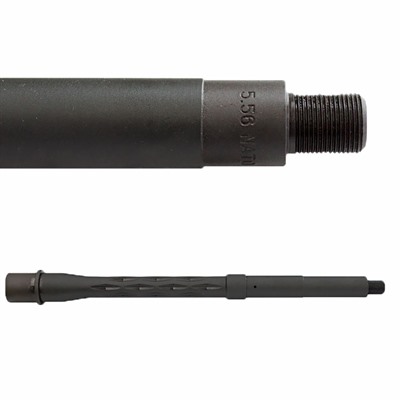
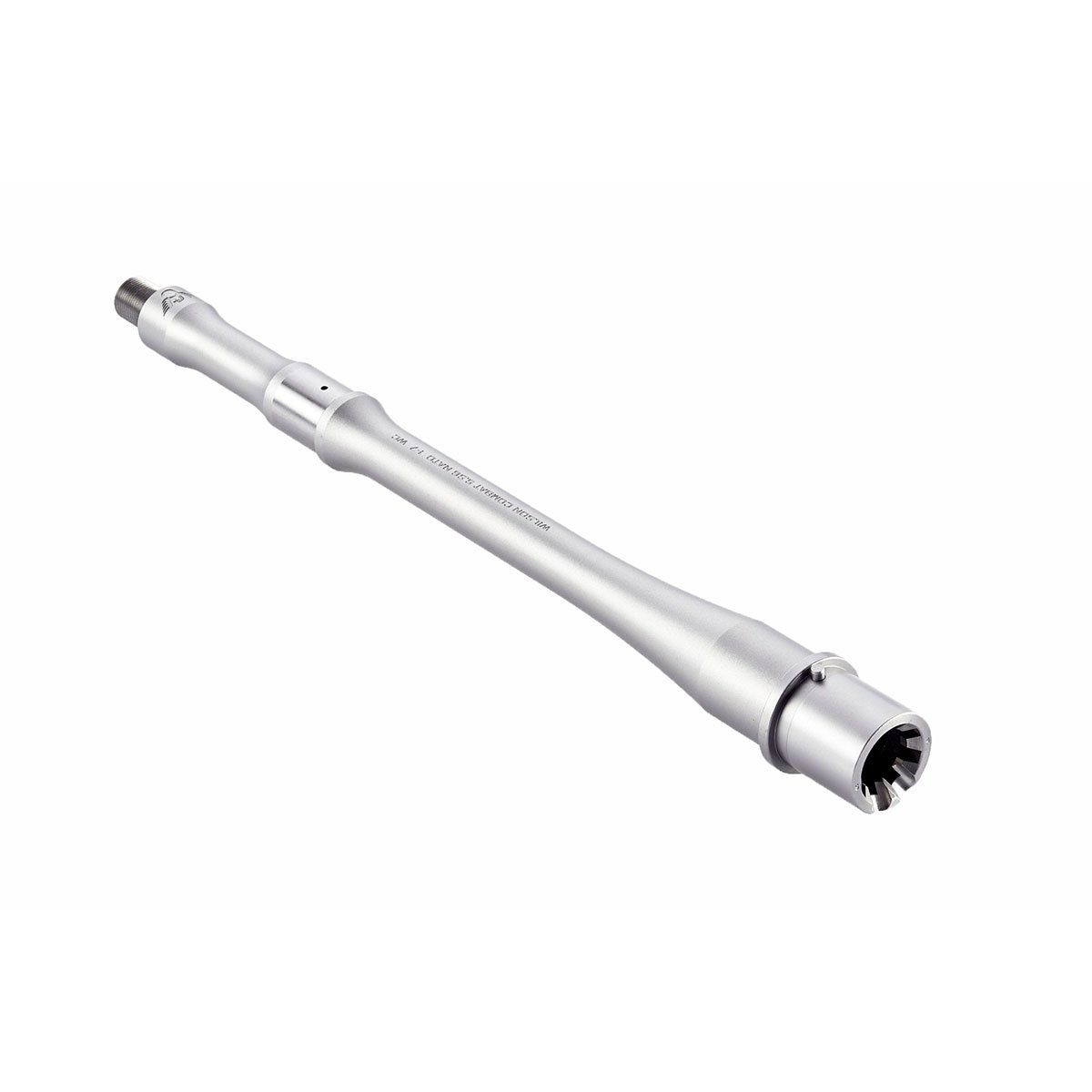

The Sweet Spot: 14.5" Pin and Weld
A 14.5" barrel with a permanently attached muzzle device (pin and weld) that brings overall length to 16"+ avoids NFA classification entirely. This is the most popular barrel length for duty and serious-use rifles — and our build data backs that up.
You get mid-length gas system compatibility (smoother than carbine), nearly full 5.56 velocity, and a package that handles like a much shorter rifle. The Daniel Defense 14.5" CHF alone accounts for over 10% of all barrel selections.
Top 14.5" barrels from real builds:


When choosing a muzzle device for pin and weld, measure carefully. You need the barrel + device to reach 16.0" minimum. Most shops measure from the bolt face to the end of the device with a rod.
The Standard: 16"
The 16" barrel is the single most popular length in our data at nearly 27% of all barrel builds. It's the shortest length that avoids NFA restrictions entirely, pairs perfectly with a mid-length gas system, and delivers full 5.56 NATO ballistics.
For a first build, a general-purpose rifle, or a home defense gun that also goes to the range — 16" is almost always the right call.
Top 16" barrels from real builds:


The Long Barrels: 18" to 20"
Longer barrels shine in precision and competition roles. A 20" barrel with a rifle-length gas system is the softest-shooting, most mechanically gentle configuration possible on the AR-15 platform.
The velocity advantage over 16" is modest (50–100 fps), but the rifle gas system dwell time makes for extremely smooth cycling and long bolt carrier group life. The FN 20" CHF is the standout here — a clone-correct barrel used in the M16A4.
Top 18"–20" barrels from real builds:


If you're building a dedicated precision or competition rifle and weight isn't a primary concern, 18" with a rifle gas system is the modern sweet spot. You get nearly all of the 20" velocity advantage in a more maneuverable package.
Most Popular Barrels Overall
Data speaks louder than opinions. Here are the top 10 most-added barrels across all builds on GunPartPicker:
Most Added Barrels
Top 10 barrels by percentage of builds with a barrel selected
| Item | Share (%) |
|---|---|
| DD 14.5" CHF Mid-Length | 10.2% |
| Faxon 16" .223 Wylde Match | 8.2% |
| FN 20" CHF Govt Rifle | 6% |
| YHM 16.5" Fluted 1:8 | 4.3% |
| DD 11.5" Govt Carbine | 3.5% |
| Rosco Bloodline 14.5" M4 | 3.5% |
| Radical .450 Bush 20" | 2.6% |
| YHM 10.5" Fluted 1:8 | 2.1% |
| Triarc Track 2.0 14.5" | 2.1% |
| Wilson Recon 18" Fluted | 2.1% |
Daniel Defense and Faxon dominate the top slots. The data confirms that the 14.5"–16" range drives the majority of barrel selections.
Most Popular Barrel Brands
Most Popular Barrel Brands
By percentage of all barrel selections
| Item | Share (%) |
|---|---|
| Daniel Defense | 15.4% |
| Faxon Firearms | 14.7% |
| Rosco Manufacturing | 8.6% |
| Ballistic Advantage | 7.9% |
| FN America | 6.9% |
| Wilson Combat | 6.8% |
| Yankee Hill Machine | 6.4% |
| Radical Firearms | 3.5% |
| Bravo Company | 2.9% |
| Triarc Systems | 2.7% |
Daniel Defense leads with 15.4% of barrel selections, closely followed by Faxon at 14.7%. The mid-tier brands — Rosco, Ballistic Advantage, and YHM — have strong showing as value options.
Brand Breakdown by Gas System
Different brands dominate different gas system configurations. Here's how the top barrel manufacturers stack up across each gas system type:
Gas System Preference by Top Brand
What gas systems each brands buyers choose
| Tier | Product | Price ($) |
|---|---|---|
| Daniel Defense | Mid-Length | 55 |
| Daniel Defense | Carbine | 30 |
| Daniel Defense | Rifle | 10 |
| Daniel Defense | Pistol | 5 |
| Faxon | Mid-Length | 40 |
| Faxon | Carbine | 25 |
| Faxon | Rifle | 20 |
| Faxon | Pistol | 15 |
| Rosco | Mid-Length | 20 |
| Rosco | Carbine | 50 |
| Rosco | Rifle | 5 |
| Rosco | Pistol | 25 |
| Ballistic Adv. | Mid-Length | 35 |
| Ballistic Adv. | Carbine | 25 |
| Ballistic Adv. | Rifle | 15 |
| Ballistic Adv. | Pistol | 25 |
| Wilson Combat | Mid-Length | 15 |
| Wilson Combat | Carbine | 35 |
| Wilson Combat | Rifle | 40 |
| Wilson Combat | Pistol | 10 |
Barrel Profile: It Matters More Than You Think
Barrel profile (the external contour) affects weight, heat dissipation, and accuracy under sustained fire. The three common profiles:
- Government/M4 profile: Thicker under the handguard, thins at the gas block. Legacy design, front-heavy
- Pencil profile: Lightweight throughout. Great for handling, heats up faster
- Gunner/Hanson profile: Modern hybrid — light where it matters, reinforced at the gas journal. Best all-around
For most builders, a Gunner or Hanson profile barrel offers the best balance of weight and thermal performance.
How to Pick Your Barrel Length
- Define your primary use case — don't try to build a gun that does everything equally
- Match your gas system to the barrel length (see the table above)
- Consider your suppressor plans — suppressed guns benefit from shorter barrels and adjustable gas blocks
- Think about your state laws — some states restrict barrel lengths or overall firearm length
- Budget for quality — a good barrel from a reputable manufacturer is the foundation of accuracy
Always verify your barrel length and overall firearm length comply with federal and state law before building. NFA items require Form 4 or Form 1 approval before assembly.
Buyer's Guide: Barrels by Budget
Not every build needs a $400 barrel — and not every budget barrel is a compromise. We broke down popular in-stock barrels into three tiers based on real pricing and builder data. Whether you're building your first AR or your fifth, there's a solid option at every price point.
Barrel Price Tiers: What Builders Actually Pay
Average price and build count by tier — based on in-stock barrels with real builder data
| Tier | Product | Price ($) |
|---|---|---|
| Budget (<$175) | Avg Price ($) | 121 |
| Budget (<$175) | Builds Using Tier | 36 |
| Budget (<$175) | Models In Stock | 12 |
| Mid ($175–$325) | Avg Price ($) | 254 |
| Mid ($175–$325) | Builds Using Tier | 140 |
| Mid ($175–$325) | Models In Stock | 18 |
| Premium ($325+) | Avg Price ($) | 383 |
| Premium ($325+) | Builds Using Tier | 178 |
| Premium ($325+) | Models In Stock | 10 |
Budget Tier: Under $175
If you're building on a budget, you don't have to sacrifice reliability. Brands like Rosco, Ballistic Advantage, and Anderson deliver proven 5.56 barrels with nitride or phosphate finishes, proper feed ramps, and enough accuracy for any practical application. These barrels won't win benchrest competitions, but they'll run thousands of rounds without complaint.


The Rosco Bloodline 16" is one of the most-added barrels on GunPartPicker at this price point — 20 builds and counting. It's a proven mid-length gas barrel with a chrome-lined bore for under $155. Hard to beat for a first build.
Mid Tier: $175–$325
This is where the value-to-performance ratio peaks. You're getting match-grade chambers (.223 Wylde), premium stainless or chrome-lined bores, and brands that professional shooters trust. The Faxon 16" Match Series alone appears in 92 builds — the single most popular barrel on GunPartPicker — and it lives in this tier.

The mid tier is where most experienced builders land. You get 90% of premium barrel performance — sub-MOA potential, chrome-lined or stainless match bores, and military-spec materials — without the premium price tag. If your barrel budget is $200–$300, you're in the sweet spot.
Premium Tier: $325+
Premium barrels are for builders who want the best and are willing to pay for it. Cold hammer forged (CHF) barrels from Daniel Defense, hand-lapped match barrels from Wilson Combat, and chrome-lined mil-spec options from FN — these are the barrels that professional armorers, competitive shooters, and serious enthusiasts reach for. The Daniel Defense 14.5" CHF is in 115 builds — more than any other single barrel in our database.


A premium barrel won't fix poor fundamentals. If you're a new shooter, invest in a mid-tier barrel and spend the savings on ammo and training. The barrel upgrade will mean more when you can actually shoot to its potential.
Complete Your Build
Ready to pick your barrel? Use the GunPartPicker AR-15 Builder to compare barrels side-by-side, check compatibility with your gas system, and find the best price across merchants.
Frequently Asked Questions
GPP Editorial Team
AR Build Specialists
GunPartPicker guides are powered by data from real builds — what builders actually select tells the story.